Research
My work examines how interstellar gas is organized and converted into stars, from parsec-scale molecular clouds to structures on scales of hundreds of astronomical units. The projects below combine wide-area surveys with high-resolution follow-up observations to connect cloud structure, dense cores, accretion flows, and young stellar systems.
LANCET: evolution along a giant filament
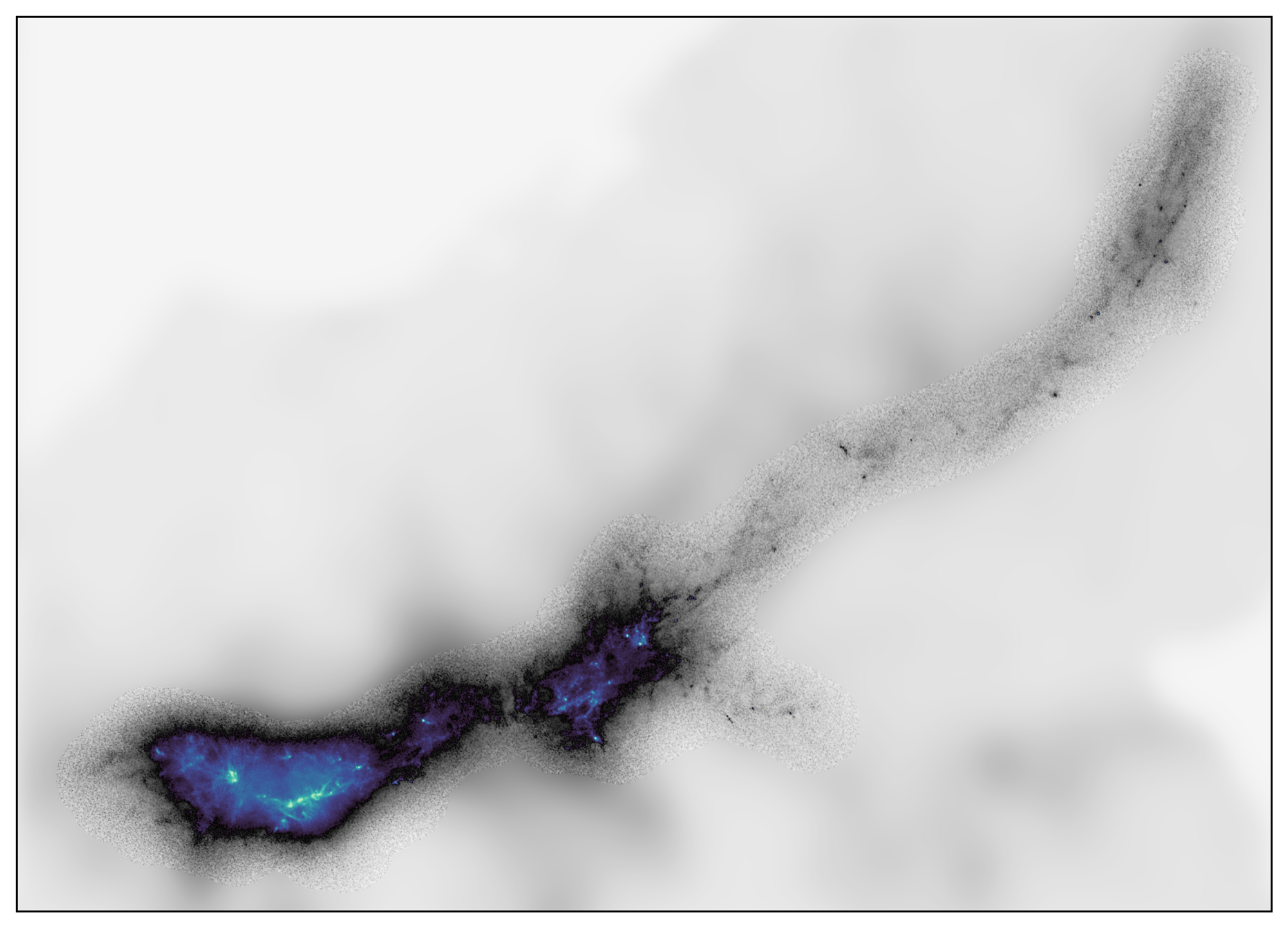
The Linear Filament and Nested Cluster Evolution Tomography (LANCET) program (ALMA project 2016.1.00909.S) uses the nearly linear, 14-pc G316.8 filament as a controlled laboratory. Its adjacent subregions contain comparable gas reservoirs but span a clear evolutionary sequence. Matched observations can therefore separate evolutionary changes from the distance and environmental differences that complicate Galaxy-wide samples.
The first LANCET results use wide-field ALMA mosaic pointings to follow how dense gas structure and star formation change along the filament (Xu et al. 2026). The second LANCET study combines observations across the full range of spatial scales—from the highest-resolution ALMA configurations to total-power single-dish data—to achieve exceptional image dynamic range and physical-scale coverage. This unprecedented data set reveals how structure emerges from molecular clouds down to dense cores (Xu et al., A&A, under review).
Forthcoming LANCET work extends this multiscale approach to the C18O (2–1) molecular line. The combined data achieve the same high angular resolution while retaining extended, large-scale emission. A velocity resolution of 0.085 km s−1 separates fine kinematic components that would otherwise blend together, allowing us to trace how gas flows through the filament and into its dense, cluster-forming structures. C18O emission also traces the molecular gas response to stellar feedback, especially around the edges of H II regions, where its morphology and velocity field can reveal material being compressed, accelerated, or dispersed by expanding ionized gas.
MagMaR: magnetic fields in a forming massive cluster
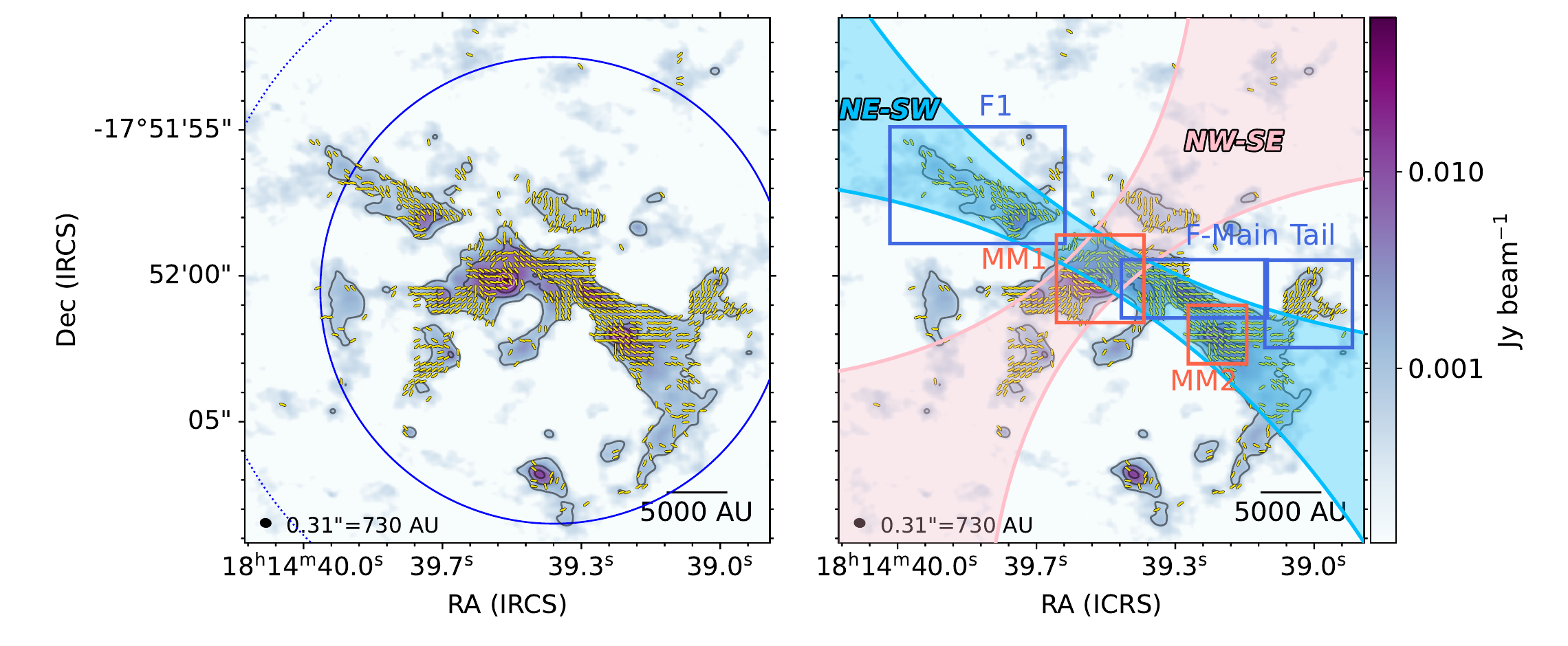
The Magnetic Fields in Massive Star-forming Regions (MagMaR) project uses ALMA polarization observations to reveal how magnetic fields guide gas as massive stars and clusters take shape. In W33 A, the observations resolve 20 dense cores and nine filaments and show that magnetic fields can play several roles within the same protocluster: supporting filaments against collapse, channeling a smooth accretion flow into the central core MM1, and delaying the collapse of MM2 (Xu et al. 2026).
Forthcoming work from ALMA project 2023.1.01606.S, Magnetic Fields in Massive Collapsing Clumps, applies a similar observing setup to 17 additional fields toward high-mass star-forming regions. This larger sample will test whether the diverse magnetic-field behavior seen in W33 A is common across massive cluster-forming environments.
DUET: star formation in the Galactic Center
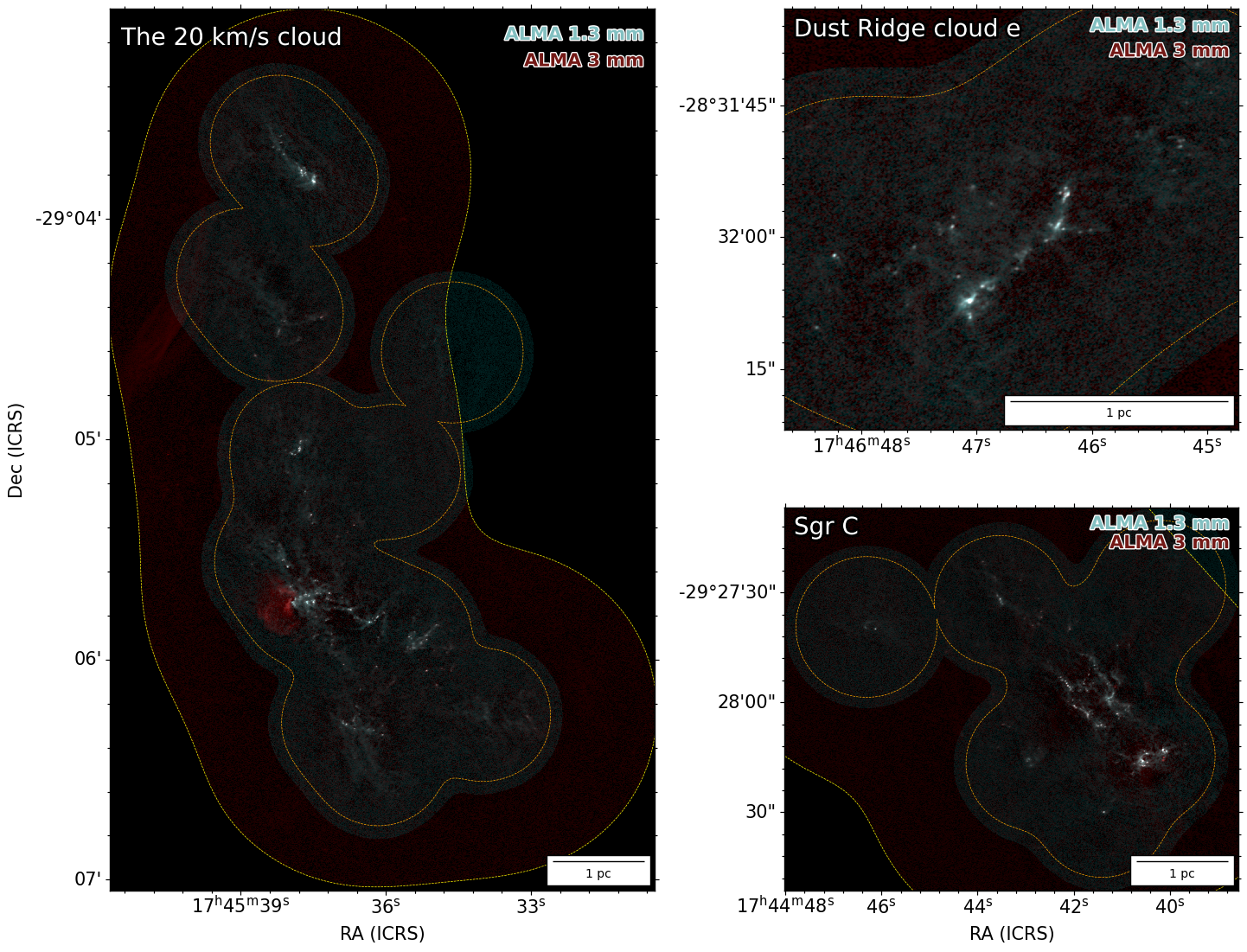
The Dual-band Unified Exploration of Three CMZ Clouds (DUET) targets the 20 km s-1 cloud, Sgr C, and dust-ridge cloud e with ALMA at 1.3 and 3 mm. The matched 0.2-0.3 arcsec resolution corresponds to roughly 2,000 au at the Galactic Center.
Project resources: DUET program · interactive magnifier
The survey produced a dual-band catalog of 450 continuum sources. More than 70% depart from commonly used modified-blackbody expectations, pointing to compact optically thick structures, dust-grain growth, or free-free contamination. These results motivate deeper tests of the low-mass protostellar population in the Central Molecular Zone (Xu et al. 2025).
QUARKS and ATOMS: a survey view of massive clumps
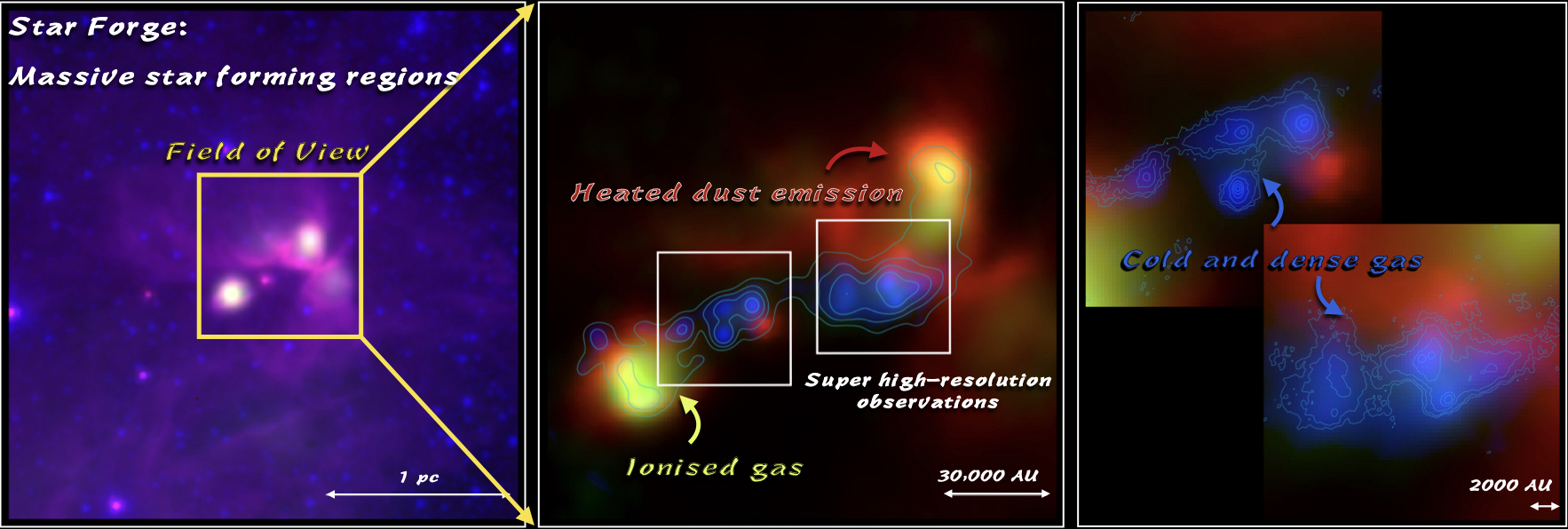
QUARKS (Querying Underlying mechanisms of massive star formation with ALMA-Resolved gas Kinematics and Structures) observes 139 massive star-forming clumps at 1.3 mm. Its combination with the 3-mm ATOMS survey provides a multiscale view of cold dense gas, molecular-line kinematics, and ionized feedback.
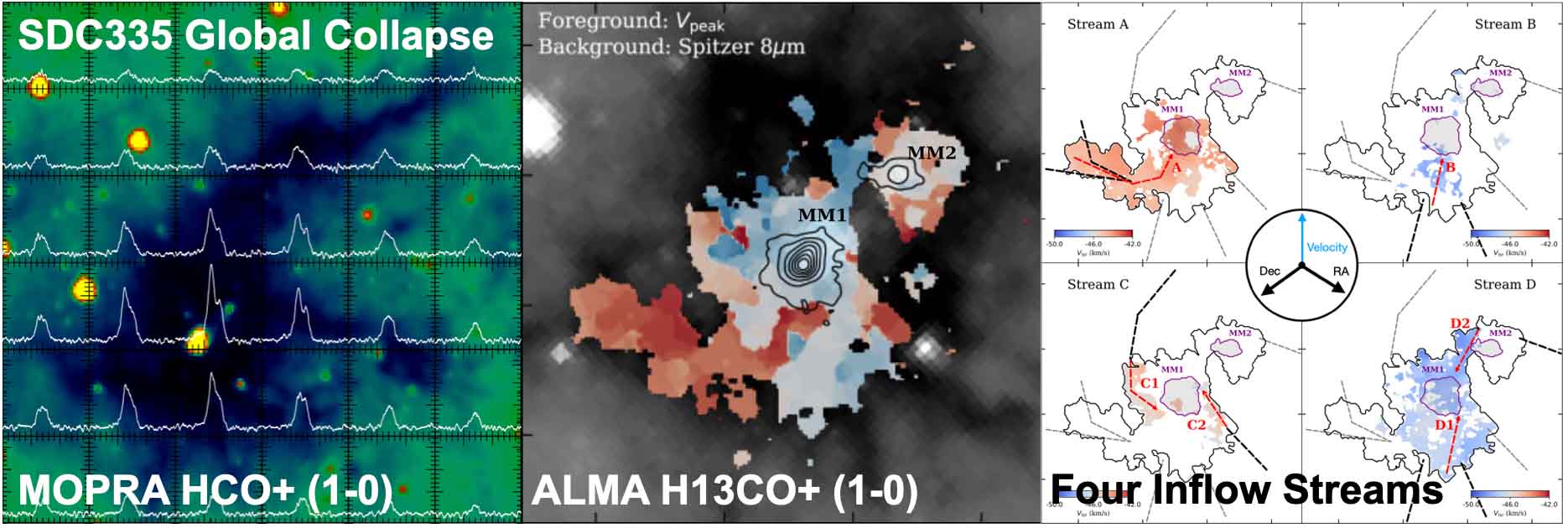
Using the compact-array component of QUARKS, I cataloged dense-gas fragments and measured an evolutionary increase in the dense-gas fraction across the survey sample (Xu et al. 2024). With ATOMS, I traced four filamentary inflow streams in SDC335 and connected global collapse to core-scale feeding (Xu et al. 2023).
ASSEMBLE: the growth of massive protoclusters
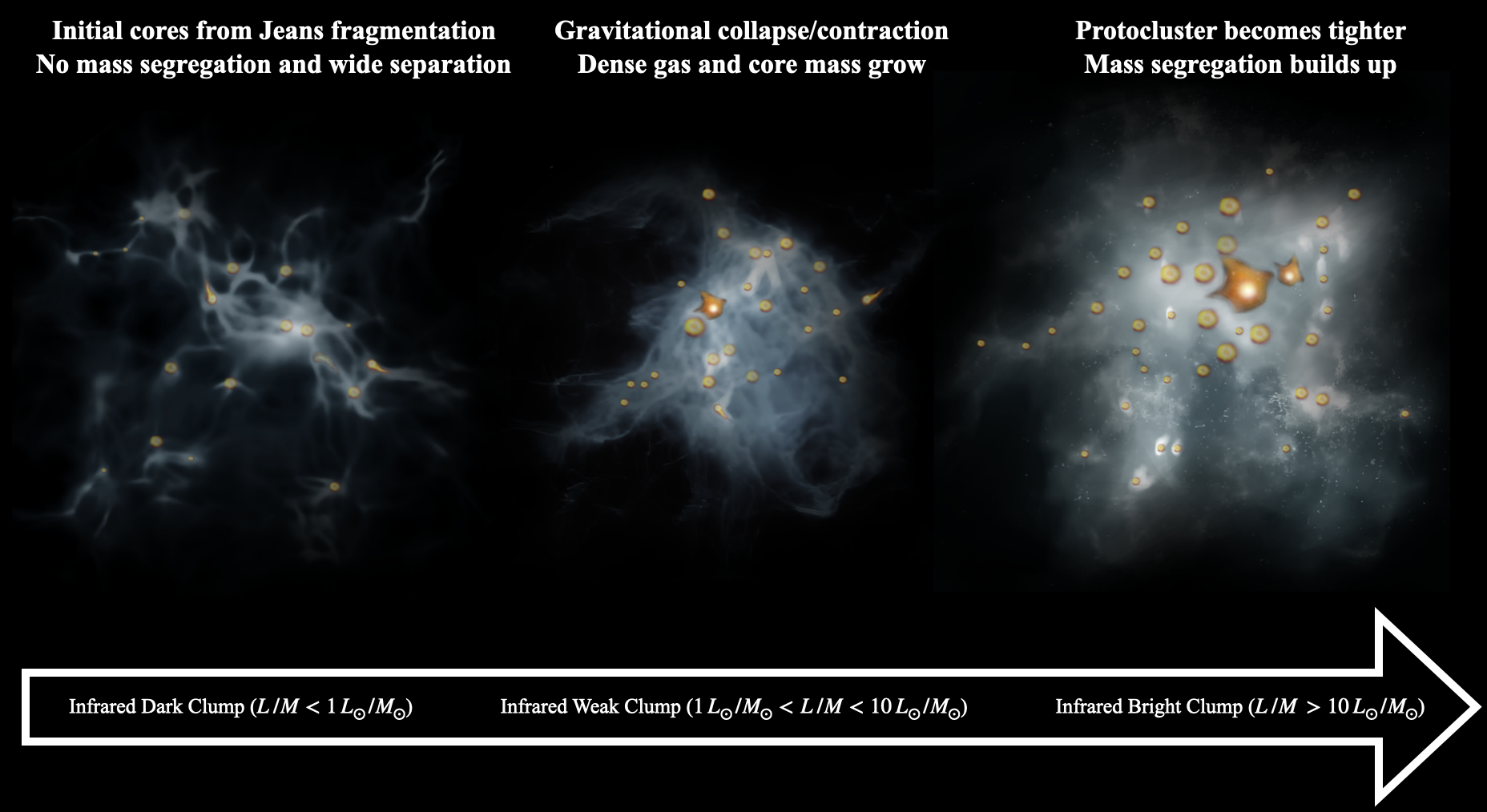
The ALMA Survey of Star Formation and Evolution in Massive Protoclusters with Blue Profiles (ASSEMBLE) studies fragmentation and accretion through an evolutionary sequence of massive protoclusters. A comparison with early-stage ASHES targets shows systematic increases in core mass and surface density, together with cluster contraction and primordial mass segregation (Xu et al. 2024).
High-latitude molecular clouds
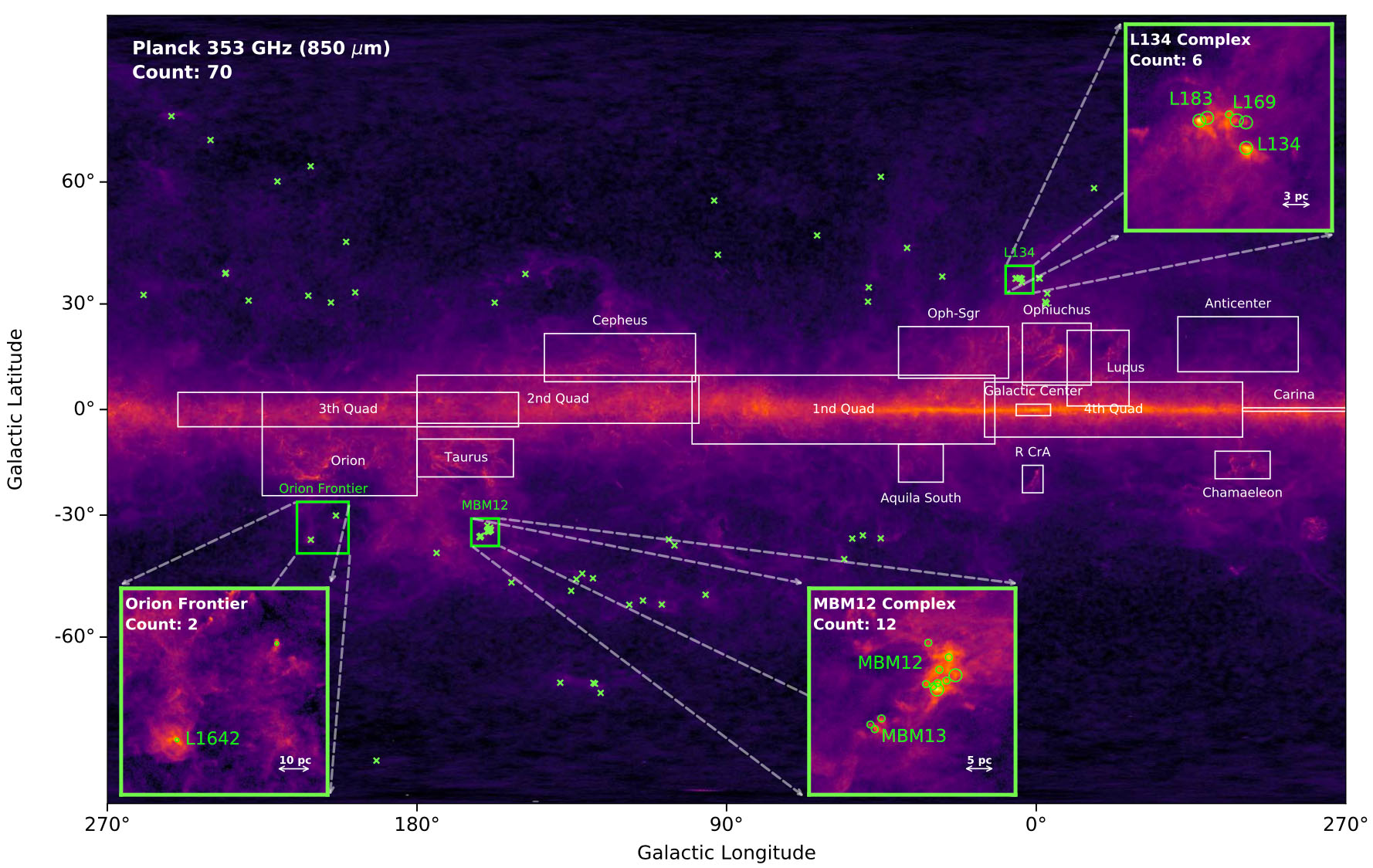
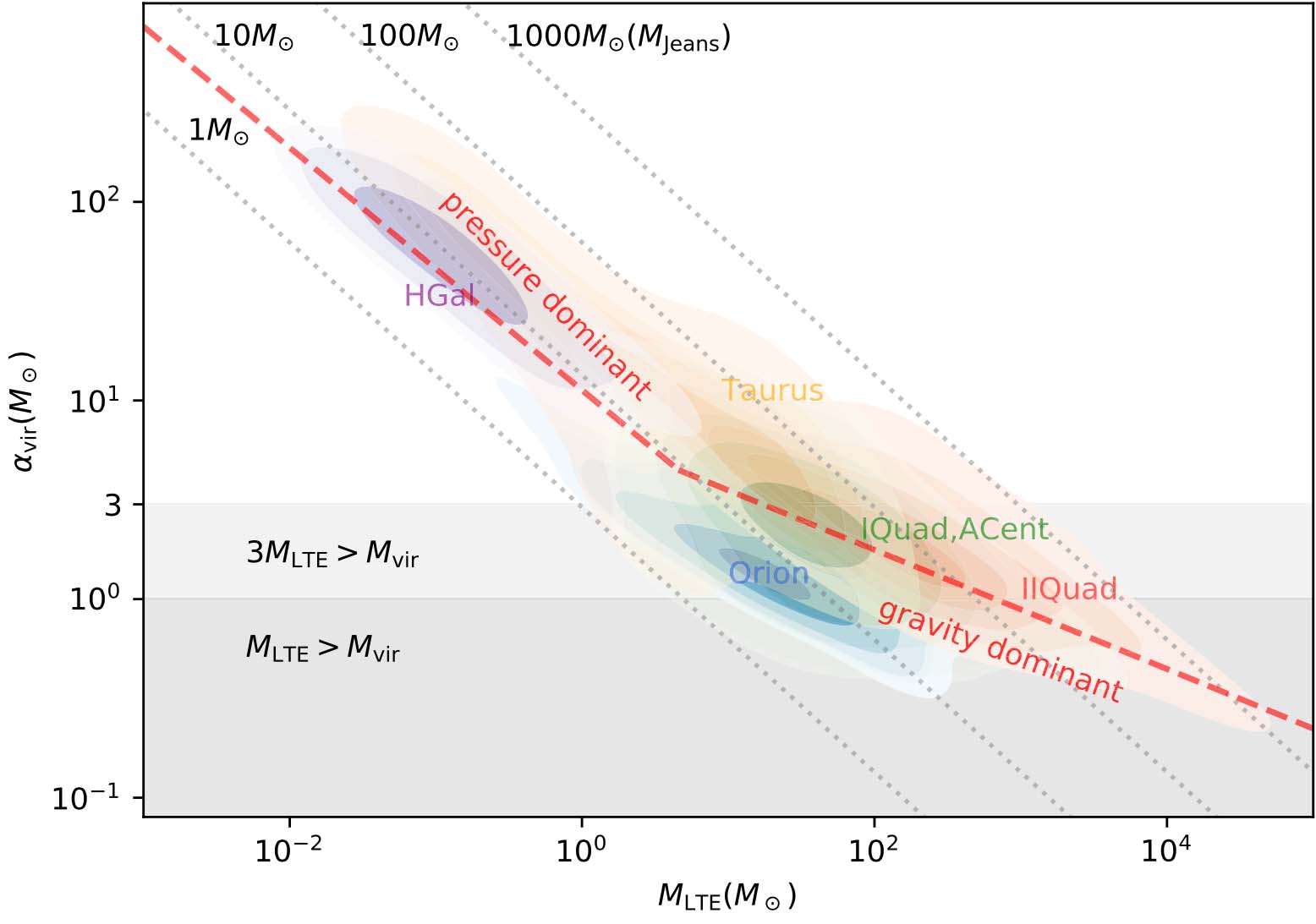
High-latitude clouds provide a nearby view of molecular gas under conditions very different from active Galactic-plane star-forming regions. A CO census of 41 Planck Galactic Cold Clumps established their cloud and core properties (Xu et al. 2021). Follow-up work found a striking scarcity of dense cores and extremely large virial parameters, constraining whether these clouds can form stars efficiently (Xu et al. 2024).